Enhancing Economics and Resilience of Greenhouse via Closed-Loop Performance-Driven Learning-Based Control
This is an ongoing project supported by the USDA NIFA Specialty Crop Research Initiative.
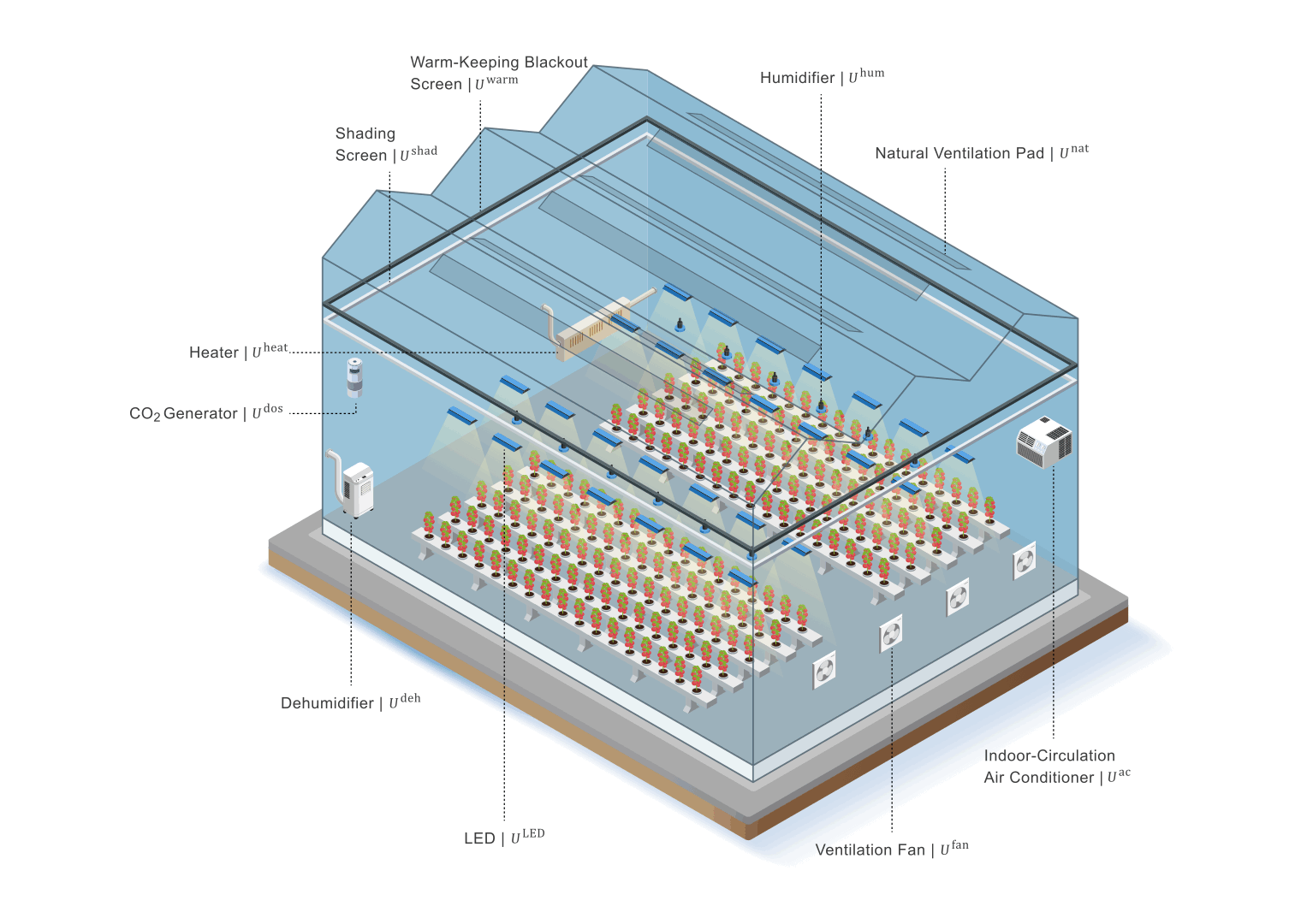
We study how to coordinate greenhouse climate control to reduce energy use while maintaining suitable growing conditions. The tomato greenhouse considered in this work includes heating and cooling, ventilation, humidity control, CO2 enrichment, supplemental lighting, and shading systems. These devices jointly influence indoor temperature, humidity, CO2 concentration, and daily light integral (DLI), making their coordinated operation essential as outdoor conditions change.
Our recent work develops an online decision-focused learning framework to augment model predictive control (MPC). At each control step, MPC uses a climate model, the current greenhouse state, and forecasts of outdoor conditions to select control actions. The first action is applied to the greenhouse simulator, and the resulting state provides the starting point for the next step.
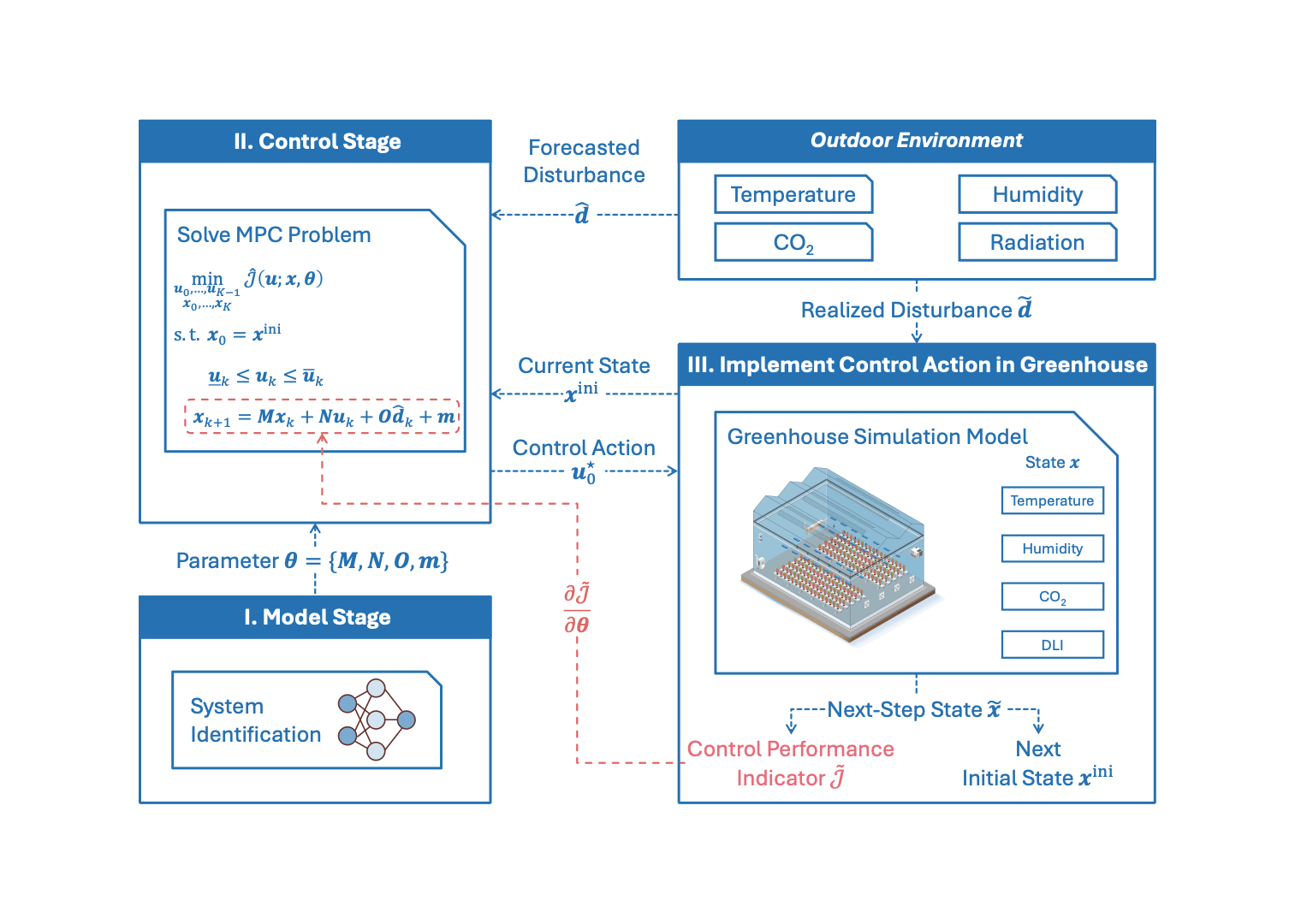
The key idea is to feed control performance back into model learning, so that online model updates directly support better control decisions. Simulations demonstrate energy savings relative to a nominal baseline MPC, with a tunable trade-off in climate-regulation performance. This work connects greenhouse modeling and operation through a shared objective: balancing energy use and climate regulation.
Related Papers
- [1] Xianbang Chen, Fengqi You. "Decision-focused learning-augmented MPC for climate control in controlled-environment agriculture greenhouses," Computers and Electronics in Agriculture, 2026. [Article »]